


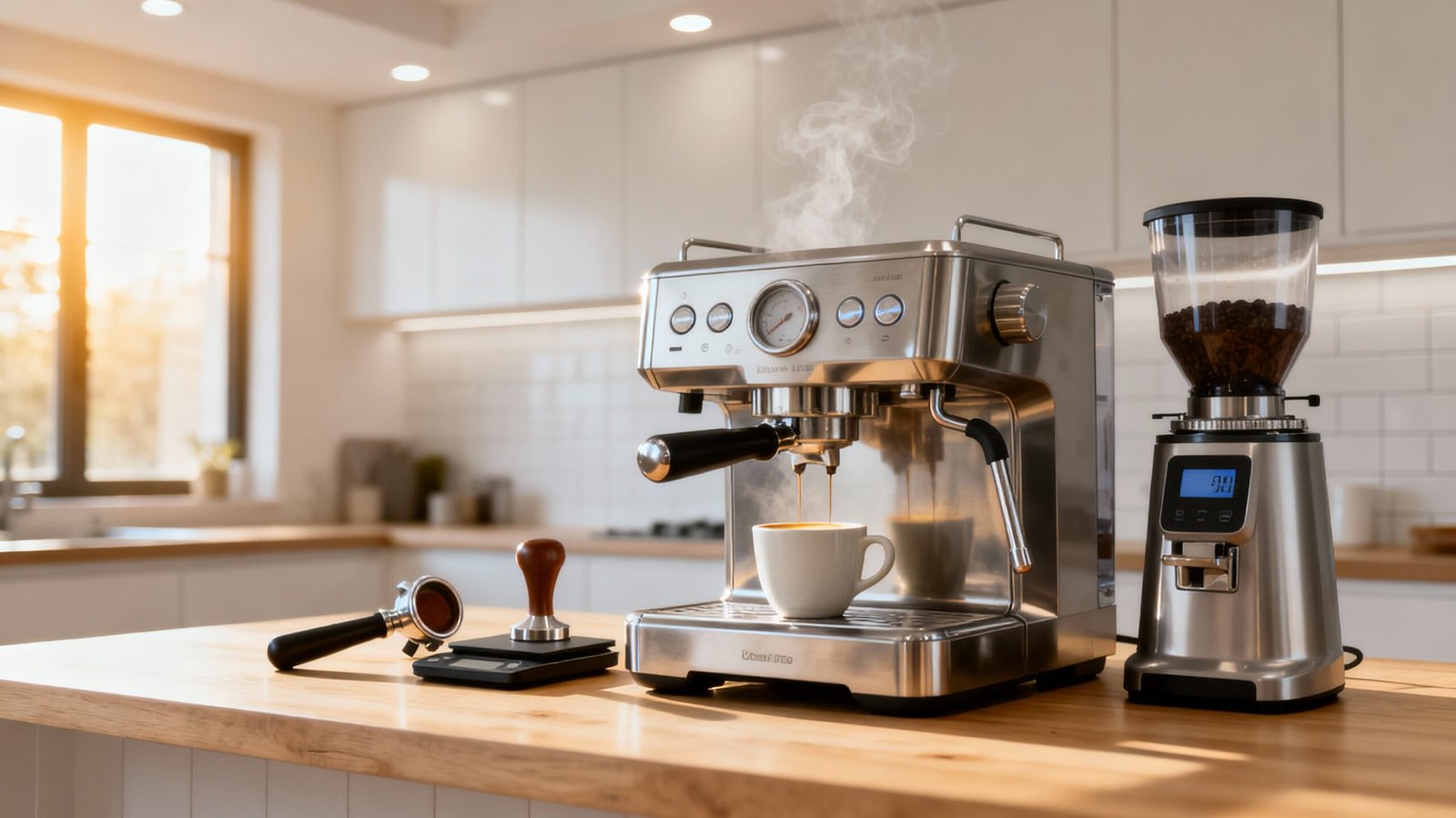
From home baristas to café owners, choosing the right espresso setup is crucial. This guide breaks down Breville and De’Longhi machines, demystifies espresso machine types and extraction, compares key models and features, and offers practical buying, maintenance, and troubleshooting tips so you can confidently pick and care for the best machine for your needs.
Espresso fundamentals and machine types
Espresso is a concentrated coffee beverage brewed by forcing hot water under high pressure through finely-ground coffee. Unlike drip coffee, the sensory goals of espresso focus on an intense, syrupy body, a balance of acidity and sweetness, and the formation of a dense cream-colored layer of microbubbles called crema. Achieving consistently rich flavor and proper crema from your coffee espresso machine requires careful attention to brewing variables and machine technology.
The journey of espresso began in late 19th-century Italy, with Angelo Moriondo patenting a steam-powered coffee maker in 1884. Luigi Bezzera improved upon this by introducing single-serve brewing, and Desiderio Pavoni commercialized the design. Early espresso machines relied on steam, but taste and safety advancements arrived in the mid-20th century, most notably with the introduction of lever-driven models. The 1961 launch of the Faema E61 marked the pivot to pump-driven espresso machines, using an electric pump to ensure precise water pressure and temperature, and setting the technical foundation for modern home espresso.
Steam-driven:
Steam-driven espresso machines operate by using pressurized steam from a boiler to force water through the coffee grounds. Typical pressures rarely exceed 1.5 bars—far less than the optimal 9 bars required for classic espresso and crema formation. Their simplicity makes them affordable, but the resulting coffee is often less expressive and lacks authentic crema. Steam-driven models may function well as a first Espresso Machine but are limited for serious espresso extraction.
Piston/lever-driven:
These espresso machines use either a manual lever or a spring-loaded piston to push hot water through the grounds. Manual-piston models rely entirely on user strength and technique for pressure profiling, while spring-piston machines automate pressure release somewhat. Lever machines allow passionate users to experiment with timing and force, giving control over nuance and flow, but require a learning curve and constant attention for best results.
Pump-driven:
Today’s best espresso machine models, including those from Breville and De’Longhi, almost always use an electric pump (often a vibratory or rotary design) to achieve stable pressures of 8–10 bars. This consistency is crucial for optimal extraction, reliable crema, and repeatable results, making pump-driven systems the standard for both home and professional coffee espresso machine setups.
Key technical factors to consider when comparing espresso machine types include:
- Boiler type and size (affects steam capacity and temperature stability)
- Single vs. double boiler (simultaneous brewing and steaming)
- Heat-exchange systems (enables multitasking in some designs)
- PID temperature control (precise digital regulation improves consistency)
- Pump type (vibratory vs rotary, affecting noise and pressure reliability)
- Pressure profiling (ability to vary pressure throughout extraction)
- Grouphead temperature stability (crucial for shot quality)
- Portafilter size (standard 58mm preferred for flexibility)
Quality espresso depends as much on grind as on machine. Built-in grinders, featured on some Breville espresso machines, offer compact convenience, while separate grinders allow for precision and upgrades over time. In practice, investing in a high-quality standalone grinder often matters more for shot consistency than the specific Espresso Machine chosen, although workflow and space may guide your choice.
Understanding the foundational espresso machine types and technical differences sets the stage for brand-specific comparisons. The way Breville and De’Longhi interpret these choices—in boiler systems, controls, and feature sets—directly shapes their respective model lineups and the experience you can expect at home.
Breville History, Approach, and Signature Features
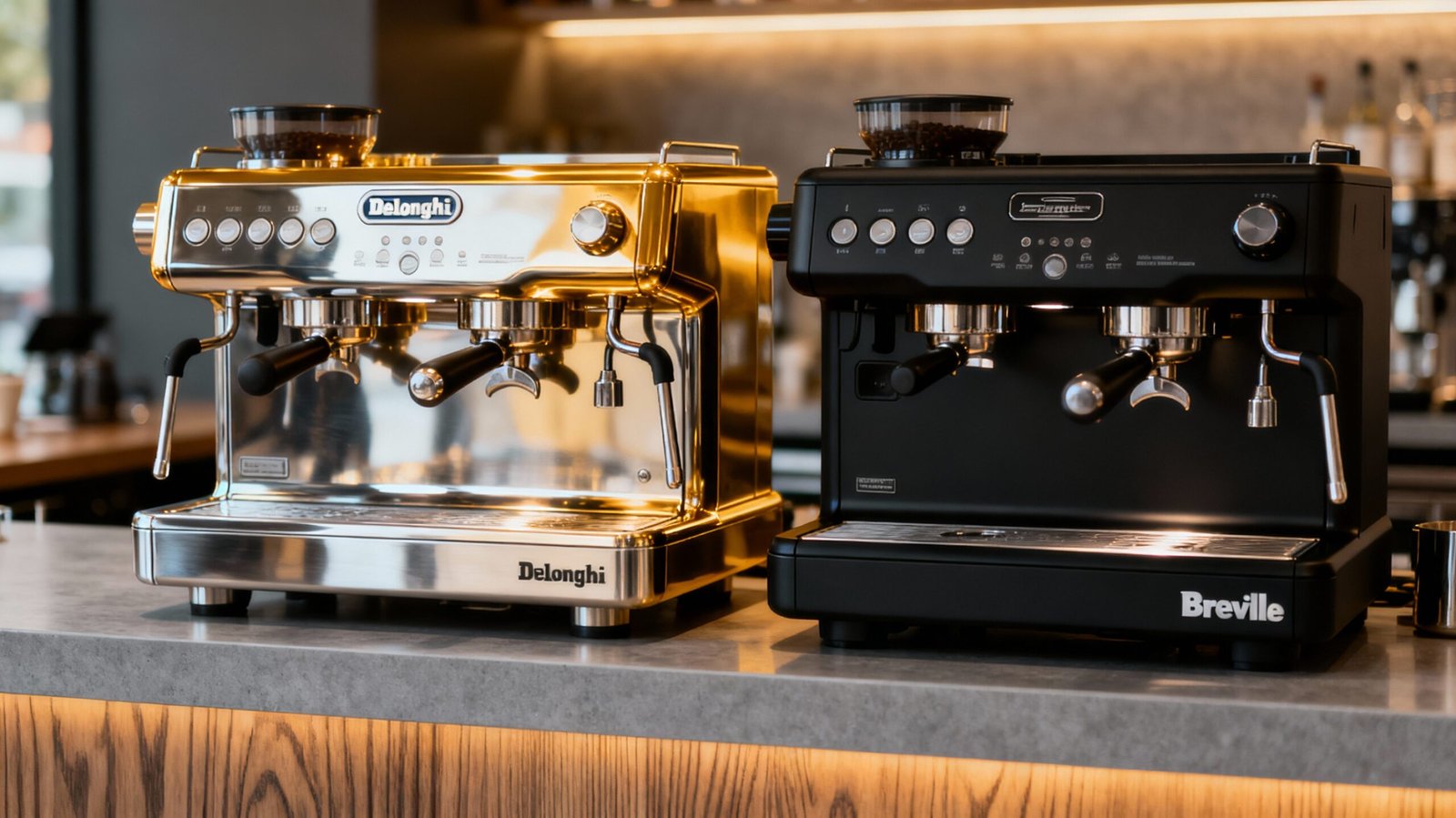
Breville, established in Sydney in 1932, has evolved from a radio manufacturer into a global leader in home appliances, renowned for its innovation-driven Research & Development culture. Today, Breville is particularly recognized for its consumer-friendly coffee espresso machines that blend advanced technology with usability. In Europe, Breville’s coffee equipment is branded as Sage due to trademark rights; partnerships with Nespresso have led to successful capsule machines, and recent acquisitions of grinder specialist Baratza and Italian espresso machine company LELIT have expanded the company’s reach into both prosumer and specialty coffee markets.
Breville positions its espresso products to appeal to home users and ambitious hobbyists who seek quality results without committing to the complexity or footprint of true commercial gear. Typical Breville espresso machine buyers value integrated convenience, such as built-in grinders and one-touch cleaning cycles, along with accessible, guilt-free controls that do not sacrifice too much on the path to a legitimate espresso experience. Models such as the Barista Express, Barista Pro, and the higher-end Dual Boiler are often cited by consumers as accessible entry points or as semi-professional options, but actual specs should always be verified, as Breville frequently updates product features.
The espresso machine Breville range is defined by several signature technical and user experience elements:
- Integrated grinders and dosers: Many Breville espresso models, notably the Barista series, feature built-in conical burr grinders. This simplifies workflow and helps users produce more consistent coffee espresso machine results without needing to master standalone grinder calibration.
- Intuitive dosing and tamping workflows: Breville pioneered user-friendly “smart” tamping, with devices like the Smart Tamper accessory and hands-free portafilter cradles that support correct dose and minimize mess.
- Programmable shot settings: Even entry-level espresso machine Breville models typically offer programmable single and double espresso buttons, allowing users to adjust volumes and, on higher-end options, tweak pre-infusion times for flavor tailoring.
- Steam wand ergonomics: Swivel wands with selectable steam or hot water and custom-designed steam tips enable both novices and emerging enthusiasts to froth milk more comfortably.
- Smart temperature control: Digital PID controllers are standard even in mid-tier Breville espresso machines, stabilizing brew temperature for improved extraction consistency and repeatability.
When weighing Breville’s design choices, buyers should consider the frequent trade-offs in their espresso machine lineup:
- Usability vs. Manual Control: Breville prioritizes guided workflows and automatic routines over deep manual adjustability; this suits most home users but limits extreme tweaking favoured by some enthusiasts.
- Integrated Grinder Convenience vs. Standalone Grinder Performance: Built-in grinders are less customizable and can be tricky to service, but they streamline the morning ritual. True specialty coffee fans often pair a Breville espresso machine without a grinder (like the Bambino Plus or Dual Boiler) with a separate high-end grinder for best results.
- Price-to-Feature Relationship: Breville often delivers strong bundled value—thermoblock steam, PID, and robust warranty at competitive prices—but premium features (e.g. dual boilers, true pressure profiling) may still require investment in upper-tier models or competing commercial gear.
On service and support, Breville has established a reliable network for parts and maintenance in most global markets; however, regional branding differences (Breville in Australia, North America, Asia; Sage in Europe) can impact warranty registration and model names. Ensuring compatibility of spare parts and understanding local support channels is crucial for long-term maintenance.
As we move to De’Longhi, the comparison shifts towards Italian heritage, a distinct industrial design approach, and a different balance of features—highlighting how each company interprets espresso machine innovation for today’s home coffee drinker.
De’Longhi: Brand Heritage and Machine Characteristics
De’Longhi, established in Treviso, Italy in 1902, is a globally recognized household appliance manufacturer noted for its distinctive Italian industrial design. Originally a maker of small industrial parts, De’Longhi transitioned to consumer appliances after World War II and has since become synonymous with stylish, reliable home coffee solutions. Significant acquisitions—such as the purchase of Kenwood in 2001 and the household division of the German brand Braun—have allowed De’Longhi to expand its manufacturing capabilities and strengthen its international distribution network. The company’s range includes the famed Artista Series and numerous contemporary coffee and espresso machines celebrated both for look and function.
In sharp contrast to Breville’s Australian heritage and technology-led strategy, De’Longhi’s approach is rooted in delivering classic Italian style and user-friendly automation. De’Longhi targets a broad user base, from first-time buyers to experienced home baristas, but especially appeals to users seeking minimal-fuss, “press-and-go” espresso experiences. The design language prioritizes sleek lines, chrome finishes, and compact footprints that fit elegantly in modern kitchens.
A defining element of many espresso machine DeLonghi models is their focus on automation. Numerous models offer true bean-to-cup operation with integrated grinders, automatic tamping, and single-touch beverage buttons—features that are especially prominent in the Magnifica and Dinamica lines. For casual and busy households, the convenience of filling the water tank and bean hopper, then pressing a button for cappuccino or espresso, is a core benefit. De’Longhi also engineers a wide array of semi-automatic and manual filter espresso machines, often including thoughtful touches such as removable drip trays, cup warmers, and clearly labeled controls.
Durability and finish are other longstanding strengths for delonghi. The company’s Italian design expertise is evident in the quality of plastics, thickness of chrome, and overall solid construction. Owners frequently cite easy cleaning and basic maintenance as additional draws. However, service and spare parts support can vary by region; while international coverage is strong, some replacement components may only be available from official channels, potentially affecting those who prefer DIY repairs or third-party upgrades.
How De’Longhi Differs from Breville:
- Automation and Workflow: De’Longhi emphasizes push-button automation and total bean-to-cup convenience, while Breville typically provides more hands-on control and manual steps, catering to hobbyists.
- Design Language: De’Longhi machines sport a polished, distinctly Italian appearance—chrome accents, soft contours, and smaller footprints; Breville tends toward an industrial, professional aesthetic with tactile metal parts.
- Ergonomics: User interfaces on De’Longhi machines are directed at maximized simplicity and low learning curve; Breville balances ease-of-use with adjustability and technical feedback.
- Price/Feature Balance: De’Longhi typically prioritizes all-in-one automation at a certain price bracket, potentially trading off deeper programmability and temperature control features that Breville prosumer models might deliver for similar budgets.
Within the world of home espresso, De’Longhi often excels at delivering consistent results for users interested in convenience and design. Their machines can transform whole beans into cappuccino with a single button press, and routine maintenance for classic models is generally straightforward. However, power users or aspiring home baristas frequently note that espresso machine DeLonghi models may limit control over extraction variables such as brewing temperature, pressure, and pre-infusion time. Servicing—especially outside official networks—may also be less flexible than with some rival brands.
As we turn to how to select the right coffee or espresso machine for your personal needs and budget, it’s important to understand how these brand philosophies and engineering priorities translate into daily user experience. The next chapter offers a practical buyer’s guide and evaluation checklist, bridging design intent with real-world ownership.
Summary :
De’Longhi espresso machines emphasize Italian design and push-button automation—contrasting Breville’s hands-on approach—making them ideal for convenient home brewing.
How to choose the best espresso machine for you :
Choosing the best espresso machine for your home starts by clearly defining your coffee goals. Are you after tight, balanced espresso shots, milky lattes and cappuccinos, absolute café-level performance, maximum convenience, or the lowest possible cost? Clarity here will focus your search, whether you lean towards a Espresso Machine from Breville, Delonghi, or another brand entirely.
Prioritized Espresso Machine Buyer Checklist:
- Intended use & daily shot volume: Brew one shot on weekends, or fuel multiple daily rounds?
- Boiler type & temperature stability: Prefer fast recovery and precise heat, or is a basic thermoblock sufficient?
- Pump quality & pressure control: A stable 9-bar pump yields consistent coffee espresso machine results; advanced machines offer user-tunable pressure.
- Grinder approach: Use a separate burr grinder for quality, or prefer built-in convenience?
- Steam wand power for milk texture: Rich microfoam for latte art requires a robust, controllable steam wand.
- Ease of cleaning, descaling, and backflushing: Machines that simplify this mean better flavor and longer life.
- Spare parts & local service: Is support available nearby, and can you easily replace baskets, seals, or wands?
- Footprint & counter space: Compact or pro-sized—what fits your kitchen?
- Budget & long-term costs: Project out cost of filters, cleaning, and parts for total ownership beyond initial price tag.
Buyer Persona Recommendations (Non-branded):
- Casual drinker: Focus on user-friendliness, quick start-up, and compact size; single-boiler or thermoblock models suffice, as do automatic milk frothers. Breville and De’Longhi both compete well here, often at accessible price points.
- Home enthusiast: Value temperature and pressure stability, a quality steam wand, and the flexibility of a separate burr grinder. Breville typically appeals with more control and advanced features in this range.
- Aspiring barista/prosumer: Seek dual boilers or high-grade thermal blocks, custom pressure profiling, and robust manual steam wands. Breville’s top models trend towards this experience, but some De’Longhi machines also serve prosumers wanting automation plus customization.
- Small office or café: Prioritize daily shot capacity, rapid heat-up, metal construction, and local service access. Both brands offer middle and upper-tier Espresso Machine solutions suitable for office environments.
Shopping Red Flags:
- No local service network or difficult-to-find parts
- Closed capsule systems if you want bean or grind flexibility
- Steam wands with less than 1000W or limited maneuverability
- No visible temperature control or unclear pump specifications
When test-driving a coffee espresso machine, always request a demo shot: Ask about warm-up time, shot timing, and pressure displays. Watch for accompanied crema (color, consistency), time to yield (ideally 25–35 seconds for 18–20g in, 36–45g out), and listen for boiler or pump noise. Milk steaming is critical—try texturing milk at least once, observing steam time, heat, and microfoam quality. This hands-on comparison ensures you choose the best espresso machine for your needs, not just the one with the sleekest marketing.
Maintenance recipes troubleshooting and final recommendations
The daily ritual of making espresso brings satisfaction, but every Breville espresso or espresso machine Delonghi relies on proper maintenance. Consistent care matters not only for flavor and crema quality but also for extending your machine’s life and protecting your warranty. Neglected Espresso Machines accumulate scale, oils, and grime—leading to weak extraction, off-flavors, and mechanical problems.
Daily maintenance for any coffee espresso machine (Breville, Delonghi, or others):
- Wipe the steam wand immediately after use and purge with steam to prevent milk residue buildup.
- Purge the grouphead (run water through) before and after pulling shots to clear old grounds and oils.
- Empty and rinse the drip tray and used coffee basket to deter mold and keep sensors functioning.
Weekly routine:
- Backflush with a cleaning detergent (if machine permits; consult your manual, as some Delonghi models may be excluded).
- Soak and scrub the portafilter, baskets, and grouphead shower screen to remove stubborn oils.
Monthly/periodic maintenance:
- Descale the system if your water is hard or the indicator prompts you. Use only manufacturer-approved products.
- Check, clean, or replace the water filter in the reservoir (especially in Breville espresso models).
- Clean grinder burrs or blades (both integrated and stand-alone choices) to prevent clogging and ensure even grounds.
Troubleshooting the best espresso machine issues—symptoms, causes, and fixes:
- Weak crema: Old beans? Try fresh, medium/dark roasts. Grind too coarse? Adjust finer. Low pressure or leaking gasket? Clean, reseat, or replace parts.
- Sour or over-extracted shots: Sour means under-extraction: finer grind, hotter water, longer shot time. Bitter/over-extracted? Use a coarser grind, cooler water, shorten extraction.
- Channeling (uneven puck): Tamp evenly, distribute grounds with a distribution tool, avoid overfilling.
- Poor steam power: Check if descaling is overdue; clean steam tip holes; ensure boiler is fully heated—wait for ready lights.
- Grinder clogs: Use dry, clean beans; open and inspect burrs monthly; declump and brush fines away.
- No heat/does not brew: Confirm power, plug resets, try basic reset. If still cold, seek service—heating elements may need expert attention.
Key milk steaming and latte art tips (for Breville espresso and Delonghi models with a manual wand):
- Technique: Always start with chilled milk in a stainless pitcher. Position wand just under the surface; introduce air (“chirp” sound) until body warms.
- Proper swirling: Submerge further to create a vortex and blend foam for microfoam suitable for latte art.
- Temperature: Target final milk temperature between 140–150°F (60–65°C). Too hot will scald; too cool lacks texture.
Recommendations for final setup choices:
- Best starter: Entry Breville espresso or basic espresso machine Delonghi plus dedicated burr grinder. Ideal for first-timers wanting reliable, repeatable quality at home.
- Midrange prosumer: Semi-automatic Breville Barista Express/Pro or equivalent Delonghi La Specialista with PID, pressure gauge, and strong steam. Suits passionate home baristas eager to experiment with grind, dose, and milk art.
- Best compact: Delonghi Dedica Arte or Breville Bambino Plus—narrow footprint for tight counters; maintainable and speedy heat-up. For smaller kitchens prioritizing quick, quality shots.
- When to choose Delonghi: Prefer simple operation, smaller form, or a broader range of compact and super-automatic espresso machine models.
- When to choose Breville: Value more semi-automatic control, specialty shot features, advanced steaming, and third-party accessory options.
For readers determined to own the best espresso machine for their style, the difference is in the details—and in the consistency of care you provide. Bookmark these checklists, maintain your equipment, and revisit this guide whenever you need advice or a new Espresso Machine comparison.
Conclusions
Whether you favor Breville’s user-friendly innovation or De’Longhi’s Italian design, understanding pump types, grinders, boilers and routine maintenance delivers better espresso. Match features to your budget and skill, prioritize a quality grinder and water, and follow the care steps here. Use this guide when upgrading or troubleshooting to make confident, coffee-driven choices.