



Affiliate Disclosure: Coffee Journals may earn a small commission on qualifying purchases made through links in this article, at no extra cost to you. We only recommend products we have independently evaluated. Learn more about how we review products.
✦ Last Updated: April 2026
When you buy a SMEG appliance, you are not just buying a coffee maker; you are investing in a piece of Italian kitchen art. Known worldwide for their iconic 1950s retro-style aesthetics, SMEG machines are undisputed status symbols. However, for a long time, coffee purists debated whether these gorgeous machines actually brewed coffee that justified their premium price tags.
In 2026, SMEG completely revamped their lineup, proving that they offer far more than just a pretty face. From standard manual brewers to fully automated bean-to-cup systems, and even a $1,500 semi-professional powerhouse equipped with triple thermoblocks, finding the right smeg espresso machine now caters to everyone from casual morning drinkers to serious home baristas.
If you are looking to elevate your kitchen’s design while upgrading your morning latte, you need to know which model actually fits your daily routine. In this comprehensive guide, we break down the four top contenders in our 2026 smeg espresso machine review, analyzing their build quality, extraction performance, and true value for money to help you make an informed, stylish investment.
SMEG Fully Automatic (BCC12) — The Perfect Balance
While SMEG offers machines that are more expensive, the Fully Automatic BCC12 represents the absolute best value for the majority of buyers searching for a reliable smeg espresso machine. It hides a powerful 19-bar extraction system and a built-in grinder behind a beautifully minimalist brushed aluminum front panel. It delivers 6 distinct one-touch beverages without requiring any barista skills, making it the smartest way to bring SMEG luxury into a busy household.
Reviewing the Best SMEG Espresso Machines
From manual brewing to fully automated convenience, here is an honest breakdown of SMEG’s current lineup, focusing on design, extraction quality, and who exactly each machine is built for.
SMEG Semi-Pro Espresso Machine (EMC02) — Serious Barista Tool
Brand Overview: SMEG is an Italian home appliance manufacturer founded in 1948. They are globally celebrated for collaborating with famous architects to create iconic, retro-styled appliances that function as kitchen centerpieces.A stunning $1,599 investment featuring triple thermoblock technology and a commercial 58mm group head.
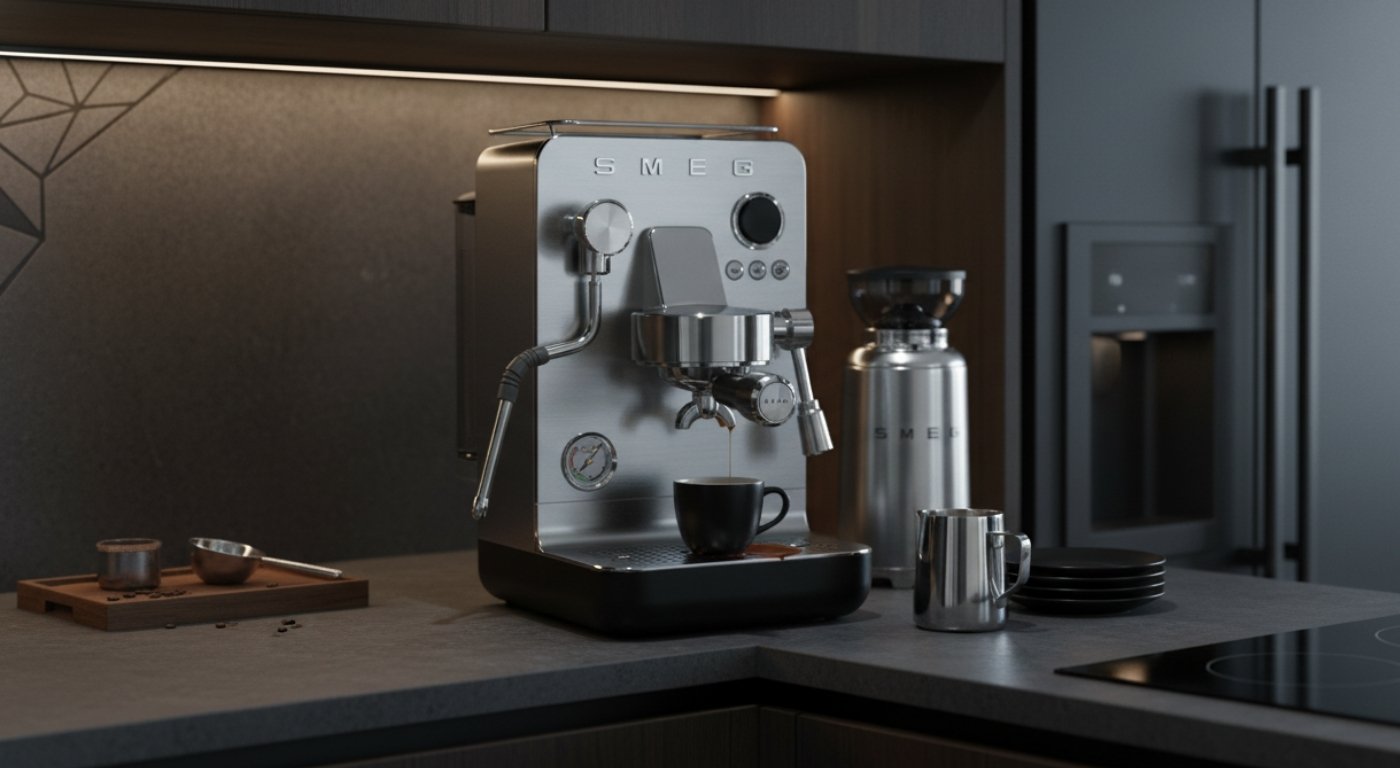
For years, coffee snobs dismissed SMEG as just a “design brand.” The EMC02 Semi-Pro is SMEG’s aggressive answer to that criticism. Priced around $1,599, this is not a toy; it is a serious semi-commercial espresso machine designed and manufactured in Italy. It features a professional-standard 58mm filter holder, which is the exact size used in high-end cafes, allowing for proper tamping and even extraction.
The true magic lies inside its heavy chassis. It utilizes Triple Thermoblock Technology—meaning it has dedicated, rapid-heating elements for the coffee extraction, the steam wand, and the group head itself. This guarantees extreme temperature stability, ensuring your espresso is never burnt or sour. While it lacks a built-in grinder (meaning you must buy a separate, high-quality burr grinder), its performance is breathtaking.
Pros
- Commercial-grade 58mm filter holder for professional extraction
- Triple Thermoblock ensures incredible temperature stability
- Integrated analog pressure gauge for precise shot monitoring
Honest Cons
- Very high price point (~$1,599)
- Does NOT include a built-in grinder (requires separate purchase)
SMEG Fully Automatic (BCC12) — One-Touch Luxury
The sleekest way to get freshly ground coffee and espresso without any manual labor.

If the Semi-Pro is for hobbyists, the BCC12 Fully Automatic is for people who want incredible coffee before they are fully awake. This machine drops the iconic 1950s curved aesthetic in favor of a striking, modern, and highly minimalist brushed aluminum design. Inside, however, it packs a massive 19-bar pressure pump and a stainless-steel burr grinder.
It is incredibly user-friendly. The top features elegant LED buttons that allow you to select from 6 different beverages (including ristretto, espresso, and large coffee). It grinds the beans, tamps them, extracts the coffee, and dumps the waste into an internal bin—all automatically. It also includes a steam wand if you decide you want to froth milk for a latte.
Pros
- True bean-to-cup automation (grinds, tamps, and brews)
- Powerful 19-bar extraction pump
- Stunning minimalist design with a remarkably small footprint
Honest Cons
- Water tank is relatively small (47-oz), requiring frequent refills
- Steam wand is manual, not fully automatic frothing
SMEG EGF03 Semi-Automatic — The All-in-One Retro Station
Combines the classic 50s SMEG look with a built-in grinder and dual thermoblocks.

Priced just under $1,000, the EGF03 hits the sweet spot for many buyers. It retains that bubbly, gorgeous 1950s SMEG aesthetic that looks phenomenal on a kitchen counter, but it integrates a high-quality conical burr grinder right into the top of the machine. This makes it an “All-in-One” espresso station.
It utilizes a Dual Thermoblock system, meaning you can transition from pulling an espresso shot to steaming milk for a cappuccino almost instantly without waiting for the boiler to reheat. It includes a professional 58mm portafilter, an analog pressure gauge on the front, and allows you to customize pre-infusion settings. It is hands-on brewing, but with all the tools provided in one beautiful package.
Pros
- Integrated grinder saves counter space and money
- Dual Thermoblocks for rapid transition between brewing and steaming
- Classic 50s retro design is visually stunning
Honest Cons
- Requires learning basic barista skills (tamping, dialing in the grind)
- Takes up more width on the counter than the fully automatic model
SMEG Manual Espresso Machine (ECF02) — Compact & Classic
The most affordable way to put a piece of SMEG art on your counter.

At around $499, the ECF02 is SMEG’s entry-level offering. It is incredibly slim (just 6 inches wide) and fits easily into the smallest apartments. It uses a standard 15-bar pump and a single thermoblock heating system to pull espresso shots from either pre-ground coffee or ESE paper pods.
While it does not have a grinder or commercial-sized filters, it is extremely reliable for what it is. The manual steam wand works surprisingly well for creating velvety milk foam for occasional lattes. It is designed for the casual coffee drinker who prioritizes kitchen aesthetics and simplicity over complex extraction science.
Pros
- Most affordable SMEG espresso machine (~$499)
- Ultra-slim 6-inch profile fits anywhere
- Compatible with both ground coffee and convenient ESE pods
Honest Cons
- No built-in grinder
- Smaller 51mm pressurized portafilter (not for professional use)
| SMEG Model | Key Advantage | Best For | Get It |
|---|---|---|---|
| Fully Auto (BCC12)~$899 · Top Pick | Minimalist design, 1-touch bean-to-cup brewing. | Busy mornings & convenience | Check on Amazon |
| Semi-Pro (EMC02)~$1,599 · Premium | Triple thermoblock, commercial 58mm head. | Serious hobbyists & pros | Check on Amazon |
| EGF03 w/ Grinder~$999 · All-in-One | Built-in grinder, Dual Thermoblocks, Retro look. | Hands-on home baristas | Check on Amazon |
| Manual (ECF02)~$499 · Entry Level | Highly compact (6″ wide), uses pre-ground coffee. | Small spaces & strict budgets | Check on Amazon |
Buying a SMEG
What to Know
Common questions before investing in a premium Italian espresso machine.
It depends on the model. Premium models like the EMC02 Semi-Pro are proudly designed and manufactured in Italy. However, some of their entry-level appliances and basic coffee makers are manufactured in China under SMEG’s strict design and quality control guidelines.
A 58mm portafilter (found on the Semi-Pro and EGF03 models) is the commercial standard used in professional coffee shops. It allows the water to distribute more evenly across the coffee puck, resulting in a significantly better, more balanced extraction compared to smaller 51mm or 54mm baskets found on cheaper machines.